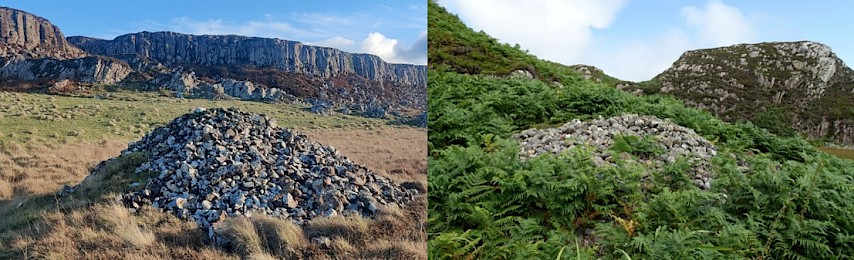
Geologist and RoMHC Trustee John Faithfull has been investigating boulder heaps in the Ross of Mull. These are distinctive features on the north-west coast of Ardtun, and on the east side of Rudh' Ardalanish, south of Torr na Sealga. He writes:
It is often suggested in the Ross that the piles of stones near the coast might be rocks brought from Tiree asballast, and left when the boats were emptied, to be loaded with peat from Mull. People from Tiree were permitted by the Argyll estates to cut peat for fuel, as their own fertile, machair-rich island had little or no peat, andthe mounds are located below moorlands where such cutting was allowed. I don’t know of any direct written or photographic evidence for the use of ballast in this activity, or what kind, or size of boats were involved, but the use of ballast on the outward journey is not implausible.
However, Tiree has very different geology from either Ardtun or Ardalanish, and any rocks brought from there would mostly be banded Lewisian gneisses, quite unlike Mull rocks. If the rocks were discarded ballast, presumably, they would be left on, or immediately beside, beaches.
Initial examinations of the stone heaps at both Ardtun, and inland from Port Faoileann na Chlachanaich on Ardalanish indicates that they are entirely made of rounded boulders of local rocks (mostly basalt in Ardtun; mostly Ross of Mull granites in Ardalanish), plus rocks found commonly in the Ross as transported glacial debris from the east (eg Dalradian quartzite, Moine psammites). The boulders are mostly sparsely vegetated compared with adjacent ground, suggesting that the heaps are not prehistoric.
The heaps are all well above high water mark, and often over 100m inland, as isolated mounds, ridges, or piled against rock faces. The sizes vary from a meter or two across, to large ridges up to 20m long, and maybe 2m high. The complete lack of exotic Lewisian rock debris indicates that these mounds were not brought from Lewisian islands, and the relatively inland locations of the largest structures strongly suggest that they are not boat ballast.
If the heaps are not ballast, and are made of local loose stones, then what do they represent? There are three groups of possibilities:
The shape of most of the mounds precludes a natural origin: they are often steep and isolated on, or beside, otherwise flattish ground. Mounds inland from Port Faoileann na Chalachainich on Rudh’ Ardalanish consist mainly of typical rounded boulders, but also contain abundant angular rotted fragments (up to boulder size) of bog iron ore. This is a relatively soft rock, which forms below or adjacent to peat bogs where there is a mixing zone with oxygenated groundwaters (eg an underlying aquifer – fractured bedrock, or sand/gravel). Formation of thick, solid units of bog iron ore probably requires prolonged stable environmental conditions for mixing and reaction of bog and oxygenated waters. As peat formation in Mull only began around five thousand years ago, the formation of thick bog iron units below peat must be later still. Any water activity capable of moving and sorting boulder-sized clasts into neat piles would have destroyed, or at least rounded, the relatively soft bog ironstones. Therefore the mounds must have been made by people, probably in historical times.
The occurrence of the bog iron ore boulders here also rules out a beach source for the boulders. Bog iron boulders are soft, and would rapidly disintegrate on any high-energy bouldery coast. If people had been carrying beach boulders to these locations to build the mound structures, there would be no bog iron ore. The occurrence of bog iron ore boulders indicates a source underneath, or in the subsurface adjacent to peat bog. The relatively intact state of the bog iron boulders indicates that the mounds are probably not very old – a conclusion also supported by the relative lack of vegetation on most of the mounds.
So far we have no evidence of any rock ballast being left in Mull which might have come from Tiree. The boulder heaps of Ardtun and Ardalanish are in, or close to areas of human habitation on poor/marginal coastal ground where cleared people were resettled after their expulsion from better land elsewhere in the Ross of Mull in the C19th. They are usually adjacent to flattish grassy or boggy ground in areas rich in rock outcrops. On these boggy, rocky, shallow-soil areas near the coast, ground could only be made cultivatable by immense physical labour to remove rocks and improve drainage. The mounds are clearance cairns - monuments to a time of brutally hard existence for so many in the Ross of Mull, and elsewhere.
Header images above: Boulder heap on NW coast of Ardtun, Boulder heap at Port Faoileann na Chalachainich, Rudh’Ardalanish
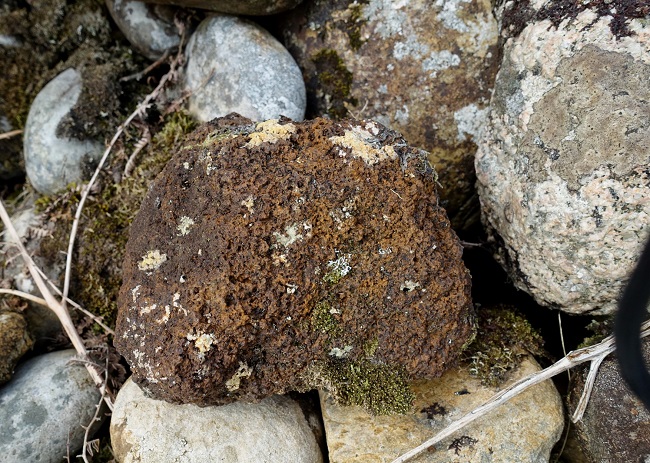
Image below: Bog iron ore boulder (centre) with boulders of granite, psammite and quartzite in heap at Port Faoileann na Chalachainich, Rudh’Ardalanish
The Ross of Mull is an extraordinary microcosm of all that draws visitors to the Hebridean Islands. The scenery, as you travel along the single-track road from the ferry at Craignure is breath-taking. You experience in the many walks in the area a true sense of wilderness; the secret bays with their beaches of silvery sand, the abundance of wildlife and the innumerable marks on the landscape of the lives of past generations and communities long gone. The Ross of Mull is a compelling place for anyone fascinated by history and the ancient way of life of the Gaelic people.
By Phone: 01681 700659 By Email: enquiries@romhc.org.uk
Our museum is open Monday - Friday, 10am - 4pm