
The historic mill ruins have been stabilised. The mill interior and surrounding area has been landscaped to make it accessible so you can easily explore. Fabulous interpretation boards have been created by local artist Stephen Raw and illustrator Jonathan Bean showing how the mill looked and worked in its heyday in the 19th century.
There are 7 interpretation boards situated around the interior of the mill. Each one is a combination of researched text, historical and recent photos along with drawings by Jonathan Bean depicting how the mill may have looked when operational. All the illustrations are based on educated guesses of how our mill may have operated. There are no written records so we only have other mills, the ruins of this mill and what remains of the machinery to construct a plausible picture.
What follows is a small selection of the information contained on the interpretation boards. We hope it will encourage you to come visit and see the rest and walk around the mill imagining it in operation.
History of the Mill
The walls are all that remain of a two storey water mill last in operation before the First World War. A single storey mill on the same site is first mentioned in 1744 in the time of the 5th Duke of Argyll. Before this people would have used small hand querns at home or horizontal ‘click’ mills. The mill may be built on the site of one of these earlier horizontal mills.
Major alterations were made to the mill building around 1830 when improvements were made to the general management of the wider Argyll Estate on Mull. Bunessan was developed as a fishing village and the road was improved between Bunessan and Grasspoint on Loch Don where cattle were shipped to the mainland. A first floor and a grain drying kiln were added at this time and the 3.3 m (11 ft) waterwheel that turned the millstones was replaced by a 4.3 m (14 ft) overshot wheel. The mill lade was also improved.
The Bunessan mill played a central role in everyday life on the Ross of Mull. Farmers and crofters had to bring their grain to the mill since Argyll Estates no longer allowed milling to take place at home.
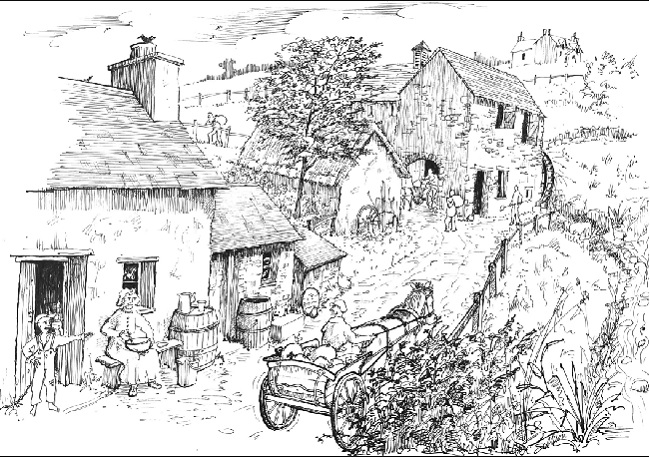
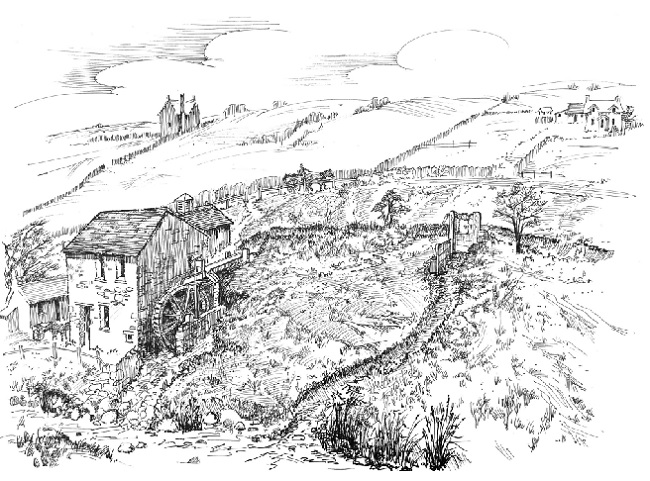
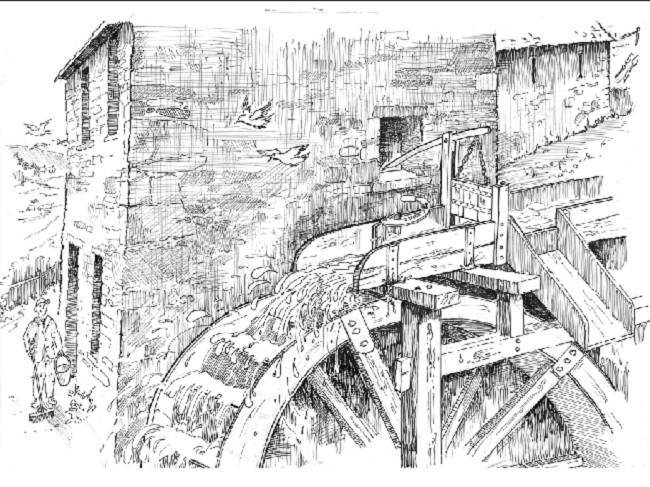
PIcture 1: Cart going up lane to mill. Caption: The artist’s impression of the mill and surrounding buildings as it might have looked in the 1890’s
Grinding Grain
Oats were likely one of the main grains to be ground at the mill but in the 18th century, bere (an old form of barley) was common. Most people ground their grain at home using a quern but the landowner (Argyll estates) who ran the mill made it illegal to use these, so people had to bring their grain to the mill and pay for it to be ground. In feudal times, this provided an opportunity for the estate to get rent in form of a percentage of the harvest after milling.
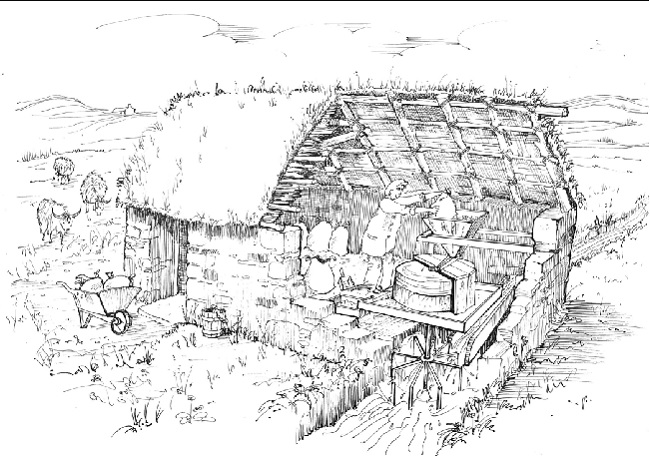
Early mills were horizontal mills with a simple wheel in the river connected directly to a millstone.
With the introduction of gearing along with a vertical wheel the milling process became more efficient and in our mill the effect of the machinery was to amplify the power of the water turning the wheel so that one turn of the waterwheel could result in 28 turns of the millstone
Picture 2: Illustration of horizontal mill. Caption: Partial cutaway of an early horizontal mill, driven directly by a stream, based on an Orkney reconstruction.
The Miller’s Work
Mills required constant maintenance. The miller was a skilled engineer and joiner who designed systems to control the flow of water and maintained the machinery.
Constant jobs for the miller (and maybe his assistant) included:
The mill was noisy, with the air full of flour dust. The miller was often working alone with big pieces of heavy, moving machinery and little protection.
The miller’s day began early. First, he ‘set the mill on’ by opening the sluice(s) allowing the water to run and turn the wheel. Secondly, he lit the fire in the kiln to make it hot enough for when the first grain was brought for drying.
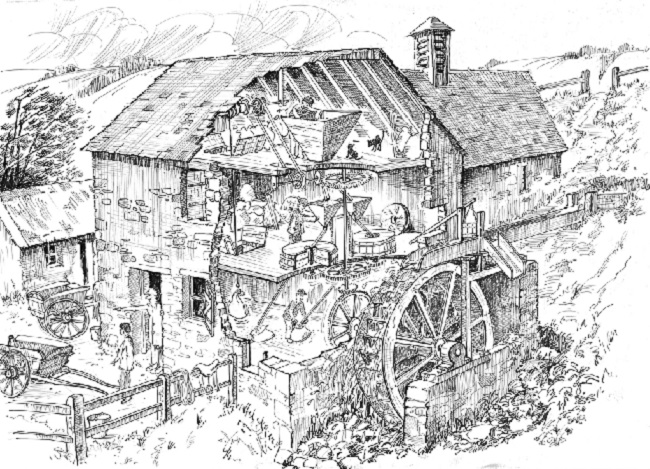
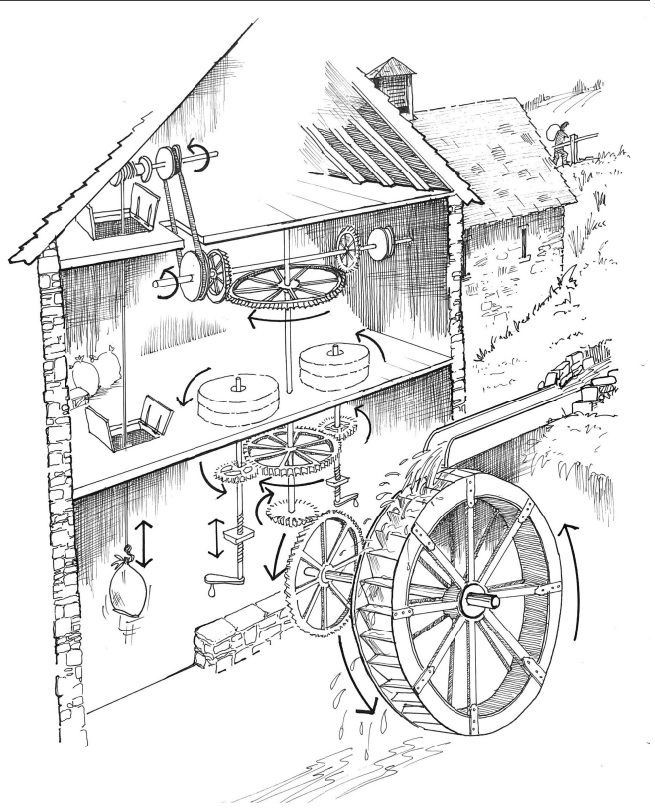
Jonathan’s drawing of a cut away of the mill shows the miller at various of his duties.
As with the other illustrations, this is an educated guess at how our mill may have operated. There are no written records so we only have other mills, the ruins of this mill and what remains of the machinery to construct a plausible picture.
Picture 3: Cutaway drawing of mill
The Millers
The earliest miller recorded at the mill was Donald McIntyre in 1744. The next mention of a miller is 1789 when the Argyll census shows the Graham family living at the mill. Duncan, aged 44, and his son Donald, 16, were the millers.
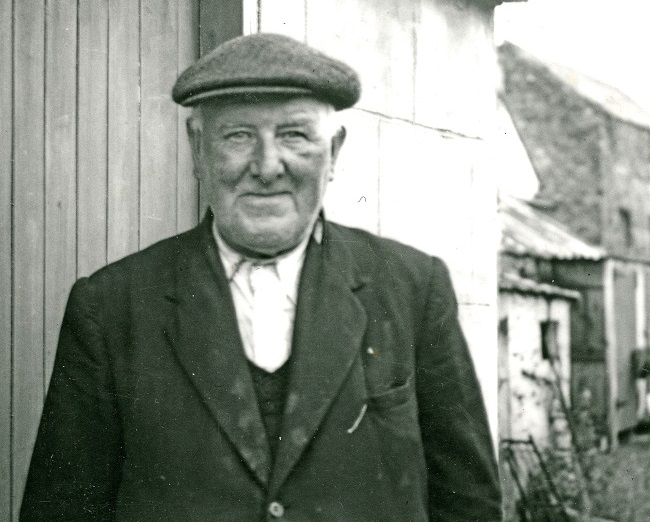
After that a patchy record in the government census records lists various millers from the mid 1800’s. By 1881 Neil and Mary McPherson were living at the mill. Neil is listed as a miller and joiner. When milling ceased they used the building as a joinery workshop. Calum McPherson, Neil’s son, was the last miller. When he joined the Scots Guards in 1914 the mill ceased to be operational.
Calum was later awarded the MBE in recognition of his work as foreman joiner in restoring the Abbey on Iona. He died in 1984.
Picture 4: Photo of Calum
The Drying kiln
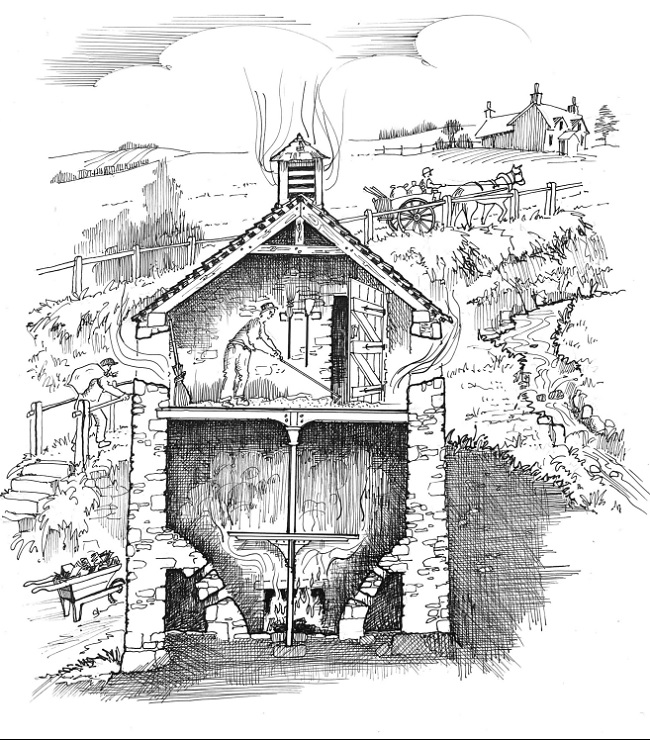
Grain needs to be dried before it can be ground with millstones. With oats the drying process is also important for removing the husks. Drying the grain, one of the most important parts of the milling process, was done in the kiln.
From the 1830s, Bunessan mill had its own kiln which was more efficient than the simple farm kilns but farmers had to pay for the use of it. It is a two storey structure built at right angles to the main mill block and is a great stone hopper about 5 m square at the top and about 3 m square at the bottom. The fire burned below the hopper, fed from an external opening at the base of the north wall of the kiln. The main fuel was peat, supplemented with oat husks from the milling process.
The grain was spread over a floor of perforated iron plates, through which the hot air from the fire passed, constantly turned with a long-handled wooden shovel and watched carefully.
How long the grain needed to be dried depended on the variety, moisture content, state of the weather when it was harvested and storage conditions. The drying process may have taken up to 6 hours before the grain was just brittle enough for grinding. An experienced miller could tell when grain was ready by cracking a sample between his teeth. One miller described how his father’s teeth had been worn down into half-moons by a lifetime of cracking oats!
In the illustration of how the kiln might have looked, the mill building in front is removed and we look directly at a cross section of the kiln.
Picture 5: Drying kiln
The Milling Process
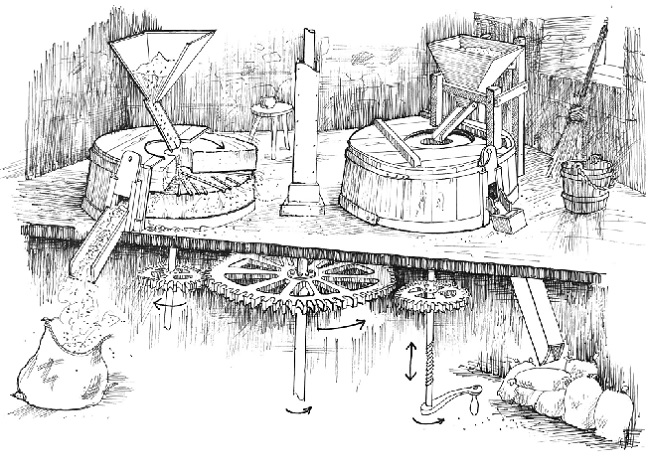
The central feature of a mill is the grinding process which uses the turning motion of the two millstones to grind the grain as it passes between them. The millstones are turned by the main shaft connected to the waterwheel.
Each pair of millstones was set one above the other, the fixed lower one was the ‘bed stone’. The upper or ‘runner’ stone was attached to the vertical drive shaft and turned over the bed stone. The grain trickled down from the hopper a few grains at a time into the hole in the centre of the runner stone. The grooves on the grinding surfaces of both stones fed the grain across the stones from the centre to the outer edge, ensuring all the grain was ground.
Only the runner/upper stone revolved and it did not come into direct contact with the bed stone as many people think. The space between the stones was minute and carefully controlled to produce the best results depending on the size of the grain. Both stones were encased in wooden hoops to make sure none of the ground meal (flour) spilled onto the floor.
Picture 6: Set up of millstones. Caption: Illustration of how the millstones might have looked in operation
Getting water to the mill
Why is the mill situated above the river? How did the water get to the wheel? Fair questions and ones that many people ask when they visit. Below is another drawing by Jonathan Bean showing how this probably happened.
The wheel is an overshot wheel which means water hits it at the top. This is a more effective means of generating power but needs a head of water above the mill. A lade (a man-made channel) brought the water from the river further up the glen and connected to the wheel via a wooden trough called a launder. The miller could control the rate of water hitting the top of the wheel by means of a sluice gate in the launder which could be raised or lowered by a lever or chain from within the mill. There were other sluice gates further up the lade and at the junction with the river to give the miller multiple ways of controlling water flow especially at times of high flow.
Picture 7: Mill and lade. Caption: Illustration of the lade as it approached the mill, showing the launder and waterwheel
Picture 8: Launder. Caption: Illustration of how the launder and waterwheel worked
The Mill Machinery
Below is a photo of the mill showing a large piece of machinery situated in the arched entrance of the mill. The bigger geared wheel is called the spur wheel and the smaller one is the wallower.
This is not where it would have been when the mill was working. Carts bringing grain and collecting flour would have been passing through this entrance. Instead, this piece of machinery was a key connector between the wheel and the millstones and by means of the gearing amplified the rotations of the wheel so that the millstones would turn much faster.
In Jonathan’s illustration, you can see the spur wheel and wallower in place connecting the pit wheel (just inside the building and connecting to the water wheel outside) to the cogs (the stone nuts) that turned the millstones.
The power of the water wheel was used in multiple ways by means of further shafts, gears and pulleys. One key function would be to operate lifting mechanisms such as the sack hoist that would lift sacks of grain up to the attic floor so that gravity could be harnessed to direct it down through the millstones.
Picture 9: Photo of machinery in cart entrance
Picture 10: Machinery assembled. Caption: Illustration to show how the machinery may have fitted together
Pictures below run 1-10 left to right, or top to bottom if viewing on a phone.
The Ross of Mull is an extraordinary microcosm of all that draws visitors to the Hebridean Islands. The scenery, as you travel along the single-track road from the ferry at Craignure is breath-taking. You experience in the many walks in the area a true sense of wilderness; the secret bays with their beaches of silvery sand, the abundance of wildlife and the innumerable marks on the landscape of the lives of past generations and communities long gone. The Ross of Mull is a compelling place for anyone fascinated by history and the ancient way of life of the Gaelic people.
By Phone: 01681 700659 By Email: enquiries@romhc.org.uk
Our museum is open Monday - Friday, 10am - 4pm